Open-Source Intelligence: Everything You Need to Know Before Using OSINT

Somewhere between things anyone can Google and things only a trained analyst would think to look for sits OSINT. It's not glamorous. There's no hacking, no break-ins, no shadowy informants. Just public records, social media posts, satellite photos, and a lot of patience turned into something useful.
Open-Source Intelligence is the practice of collecting and analyzing information that's already publicly available, and piecing it together into conclusions that weren't obvious from any single source on its own. A LinkedIn profile by itself tells you someone's job title. Cross-reference it with a company's press releases, a conference speaker list, and a few geotagged Instagram photos, and you've got a pattern of behavior. That's the whole trick: nothing in OSINT is secret, but the picture it builds usually is.
History of OSINT
OSINT is older than the internet by a wide margin. During World War II, the US set up the Foreign Broadcast Information Service in 1941 specifically to monitor and transcribe Axis radio broadcasts propaganda, troop movements hinted at in public statements, shifts in tone from state media. Analysts could tell a lot about what was happening behind closed doors just by listening to what governments said in public.
The Cold War kept the discipline alive. Newspapers, journals, and broadcasts from the Eastern Bloc were combed over for clues about Soviet capabilities, since direct access was obviously off the table. The CIA eventually folded this work into what became the Open Source Center.
The real shift happened after 2001. The 9/11 Commission and later the WMD Commission both pointed out, in different ways, that intelligence agencies were sitting on mountains of useful open information while pouring resources into classified collection. That criticism nudged OSINT from a secondary activity into something agencies took seriously on its own terms.
Then social media happened, and the field changed shape entirely. Twitter threads during the Arab Spring, geolocated YouTube clips from conflict zones, satellite imagery anyone could pull up suddenly OSINT wasn't just for governments. Bellingcat, founded in 2014, built an entire investigative model around it, most famously tracing the missile system used to shoot down MH17 using nothing but open photos, forum posts, and satellite data. That case is still the textbook example of what a determined OSINT investigation can do.
How OSINT Works
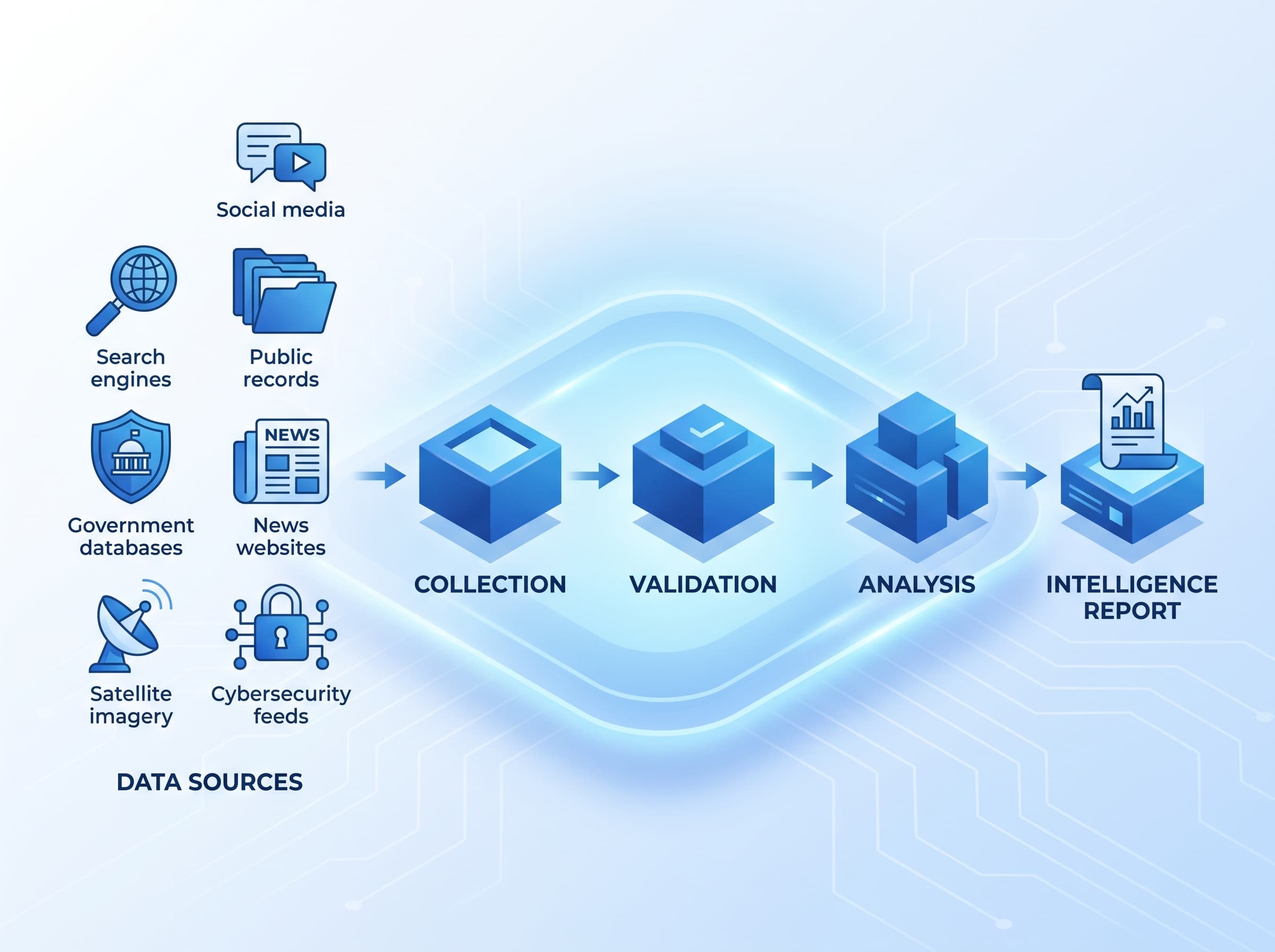
At its core, OSINT runs on three things: finding data, verifying it, and connecting it to other data. None of those steps require special access they require knowing where to look and being skeptical about what you find.
Collection can be passive (just browsing what's already indexed search engines, social platforms, archives) or active (interacting with a target system in ways that are still legal and public, like querying a WHOIS database or pulling DNS records). Most investigations use both.
The part people underestimate is verification. The internet is full of recycled photos, fake profiles, and outdated records. A skilled OSINT practitioner spends as much time ruling things out as they do finding new leads checking metadata, cross-referencing timestamps, confirming a satellite image actually matches the date it's claimed to.
OSINT Investigation Process
Most practitioners follow some version of the intelligence cycle, adapted for open sources:
- Define the objective: What question are you actually trying to answer? Vague goals produce vague results.
- Identify sources: Figure out where the relevant public data is likely to live social media, registries, news archives, technical databases.
- Collect: Gather the data using the appropriate tools, keeping track of exactly where and when each piece came from.
- Verify and process: Cross-check facts, strip out duplicates, confirm authenticity. This is where a lot of bad OSINT falls apart.
- Analyze: Connect the pieces. This is the actual intelligence part turning a pile of facts into a coherent answer.
- Report: Present findings clearly, with sourcing intact, so someone else can verify the chain of reasoning.
It sounds clean in a list. In practice it loops back on itself constantly a finding in step 5 sends you back to step 2 looking for a source you didn't know you needed.
Types of Open Sources
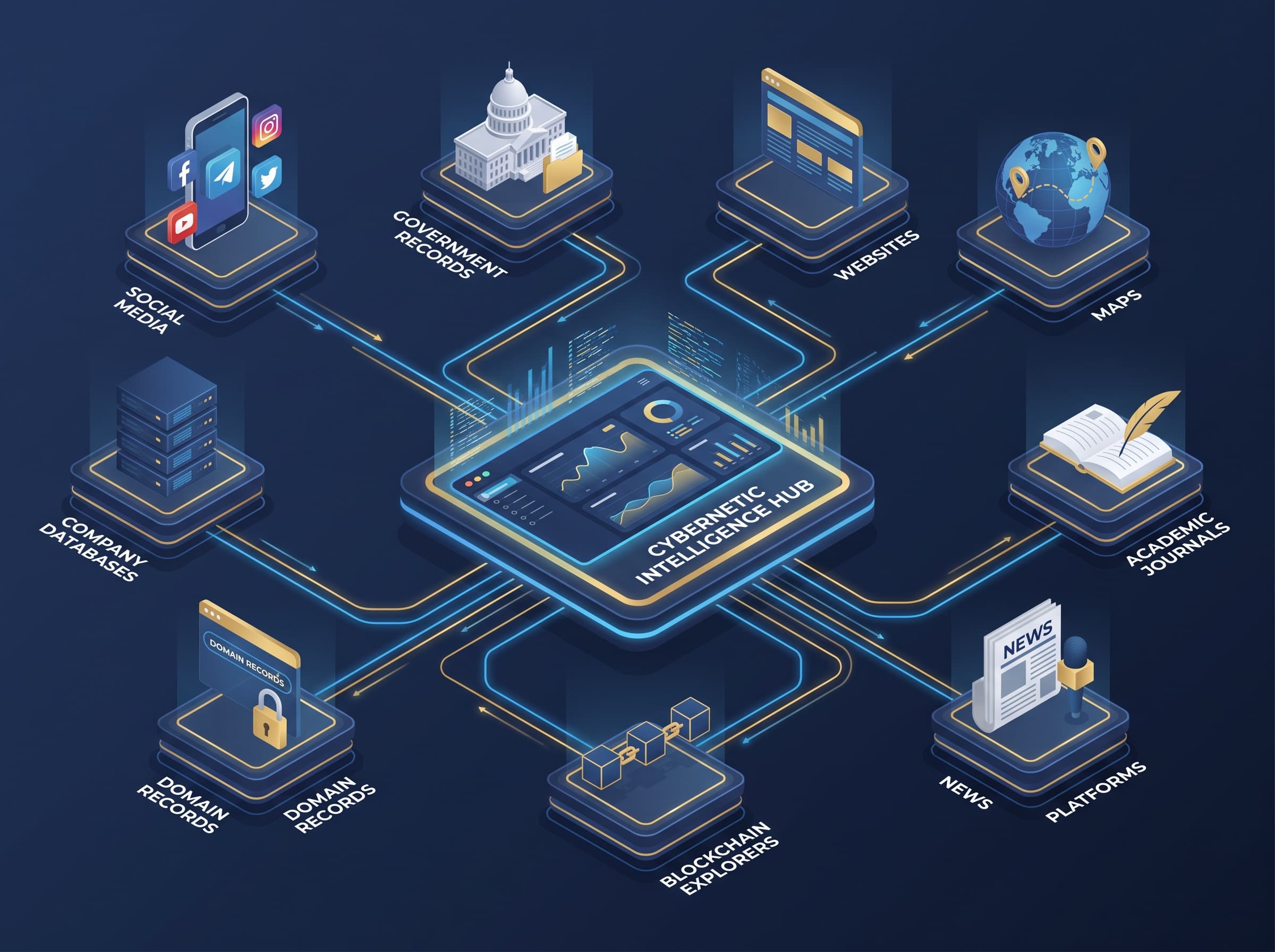
OSINT pulls from a wide range of public material, and most real investigations end up touching several of these:
- Search engines: the obvious starting point, and still where most leads originate.
- Social media: profiles, posts, photos, check-ins, and the metadata attached to all of it.
- Government databases: court records, business registries, property records, regulatory filings.
- Academic journals: published research, author affiliations, citation networks.
- News websites: current reporting and, just as often, old archived stories.
- Company websites: staff bios, press releases, job postings that reveal internal tech stacks.
- Public records: birth, marriage, property, and other civil records depending on jurisdiction.
- Satellite imagery: useful for confirming locations, timelines, and physical changes over time.
- WHOIS: domain registration data, though privacy protections have made this less revealing than it used to be.
- DNS: subdomains, mail servers, and infrastructure hints tied to a domain.
- Blockchain explorers: public transaction history on networks like Bitcoin and Ethereum, useful for tracing fund flows.
Popular OSINT Tools
- Maltego: visual link-analysis software that maps relationships between people, domains, and infrastructure.
- Shodan: a search engine for internet-connected devices, often called the search engine for hackers even though most of its use is defensive.
- SpiderFoot: an automation framework that runs dozens of OSINT checks against a target in one pass.
- theHarvester: pulls emails, subdomains, and names tied to a domain from public sources.
- Recon-ng: a modular reconnaissance framework built for structured, repeatable OSINT workflows.
- Google Dorks: advanced search operators that surface content search engines weren't necessarily meant to expose.
- Intelligence X: a search engine that indexes leaked data, historical web snapshots, and documents others have de-indexed.
- Censys: scans and catalogs internet-facing infrastructure, similar in spirit to Shodan but with a different data model.
- Have I Been Pwned: checks whether an email or password has shown up in a known data breach.
- Wayback Machine: the Internet Archive's tool for pulling up old versions of web pages, often the only way to see content someone has since deleted.
These show up constantly in cybersecurity, journalism, due diligence, and threat intelligence work. None of them do anything you couldn't do manually, they just do it faster and at scale.
Real World Use Cases
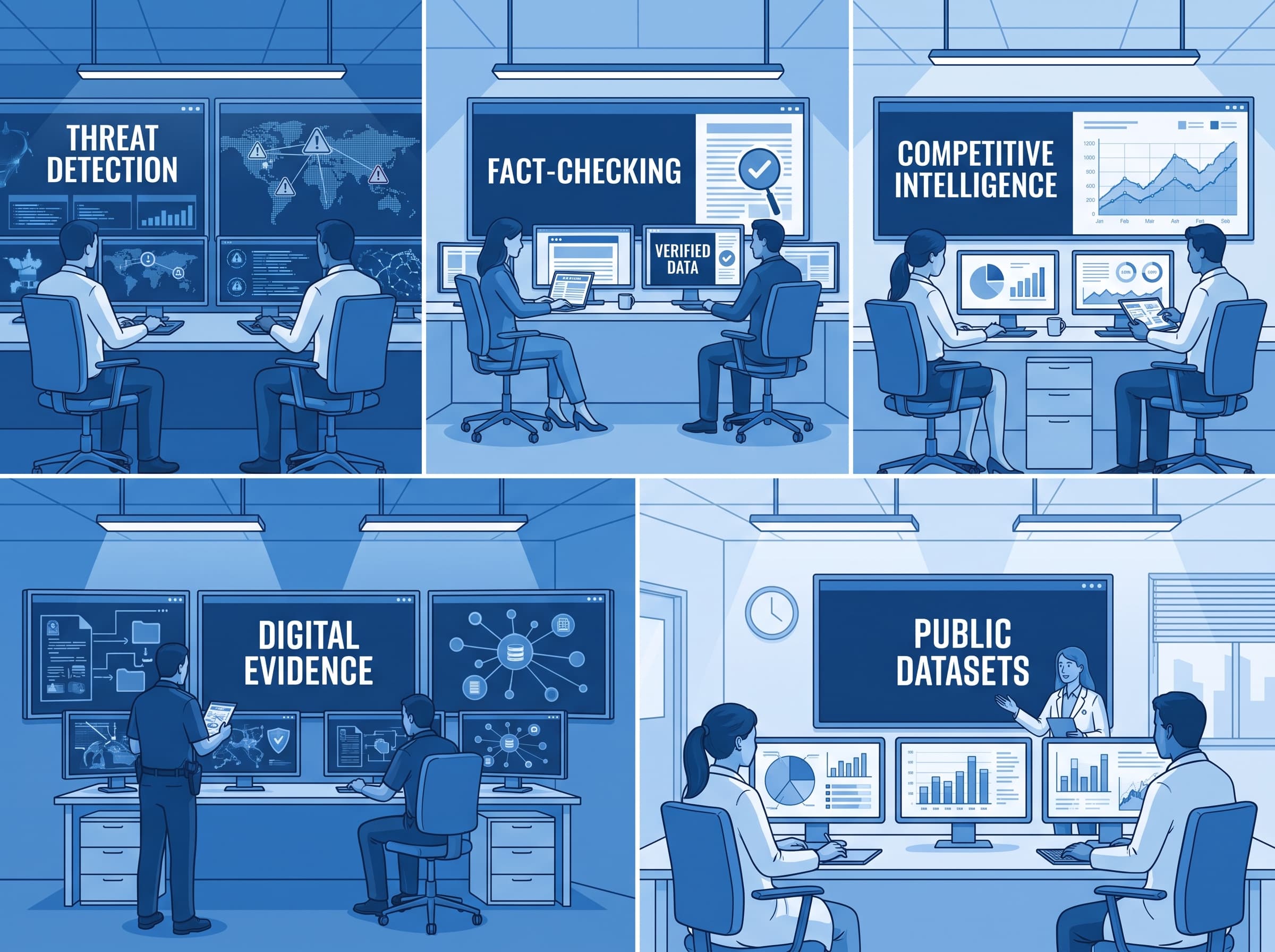
OSINT isn't confined to one industry. The same underlying skill finding public information and making sense of it gets applied to wildly different problems depending on who's holding the wheel.
Cybersecurity
Security teams use OSINT to map an organization's attack surface from the outside: exposed servers, leaked credentials sitting in breach dumps, employee details that show up in phishing campaigns. A lot of "threat hunting" starts by looking at a company the way an attacker would, using nothing but public tools.
Digital Forensics
Investigators working a case rarely rely on seized devices alone. Public records, social media activity, and metadata from photos or videos help corroborate timelines and confirm or contradict an alibi often before a warrant for anything more invasive is even issued.
Business Intelligence
Companies use OSINT to research competitors, vet potential partners, and check the background of an acquisition target before signing anything. Public filings, patent applications, and hiring patterns on job boards tend to say more about a company's direction than its press releases do.
Journalism
This is the field that turned OSINT into a public discipline rather than a government one. Reporters geolocate footage from conflict zones, cross-reference satellite imagery against eyewitness accounts, and build sourcing chains that can be checked by anyone which is part of why outlets like Bellingcat carry real weight even without classified access.
Law Enforcement
Missing persons cases, gang network mapping, and suspect background checks all lean on OSINT, usually as a starting point rather than evidence on its own. The legal limits here are tighter than in most other fields, since what's "public" doesn't always mean "admissible."
National Security
Governments still do what the FBIS did in 1941, just at a much larger scale watching state media, tracking disinformation campaigns, and analyzing commercial satellite imagery for troop movements or infrastructure changes that wouldn't show up any other way.
Fraud Detection
Insurance investigators compare claims against a claimant's own social media a supposedly disabled person posting photos from a marathon is the cliché example because it actually happens. Corporate fraud investigations lean on similar techniques to trace shell companies and beneficial ownership through public registries.
Supply Chain Risk
Companies increasingly monitor suppliers for geopolitical instability, sanctions exposure, and financial trouble using open sources news coverage, customs data, corporate filings long before any of that shows up in a formal audit.
Benefits of OSINT
- Low cost: Most of what OSINT relies on is free or close to it, especially compared to the cost of classified collection or paid data brokers.
- Massive amount of available data: Between social media, public records, and the open web, there's more raw material available now than any team could fully process.
- Faster investigations: Public data is immediately accessible no warrants, no waiting on subpoenas, no negotiating access.
- Better decision making: Decisions made with more context tend to be better ones, whether that's a hiring choice, an investment, or a security posture.
- Supports threat intelligence: Tracking attacker infrastructure and behavior in public spaces gives defenders a head start before an attack even lands.
- Helps identify cyber risks: Exposed assets, leaked credentials, and misconfigured services are often visible from the outside well before anyone inside the organization notices.
Challenges
- Fake news: Public information isn't the same as accurate information, and a lot of what circulates widely was never true to begin with.
- AI-generated misinformation: Synthetic text, fake images, and cloned voices have made it considerably easier to manufacture convincing "evidence" that was never real.
- Information overload: Having access to everything isn't the same as having time to look at everything. Most investigations drown in noise before they find the signal.
- Privacy concerns: Just because data is technically public doesn't mean collecting and compiling it feels ethically neutral to the person it's about.
- Legal compliance: Rules around data collection, surveillance, and privacy vary by country and sometimes by state, and they don't always keep up with what's technically possible.
- Data verification: Confirming that a photo, document, or account is what it claims to be is often the hardest and slowest part of the entire process.
Ethics and Legal Considerations
The fact that something is publicly accessible doesn't automatically make collecting and using it appropriate. There's a real difference between reading a public LinkedIn profile and building a detailed dossier on someone's daily movements from the same kind of "public" data the second one starts to look a lot like surveillance, even without breaking a single law.
Privacy laws complicate this further. Regulations like the GDPR in the EU treat certain categories of publicly visible personal data as protected once they're compiled or used for a specific purpose, regardless of where the data originally came from. What's legal to collect in one jurisdiction may not be legal to act on in another, and "I found it on the internet" isn't a legal defense most courts take seriously.
Verification matters just as much as legality. An OSINT finding that hasn't been corroborated is a lead, not a conclusion and treating it otherwise is how false accusations and bad headlines happen. AI tools can speed up the search and the first pass of analysis considerably, but they shouldn't be the last check before something gets acted on. A human still needs to look at the evidence and ask whether it actually holds together.
Future of OSINT
- AI-powered investigations: Machine learning is already being used to sift through volumes of data no analyst could review manually, flagging patterns worth a closer look.
- Automated risk monitoring: Systems that continuously scan news, filings, and public records for relevant changes, rather than waiting for a scheduled review.
- Deepfake detection: As synthetic media gets harder to spot by eye, verification tools built specifically to catch manipulated audio, video, and images are becoming part of the standard OSINT toolkit.
- Large language models: LLMs are showing up in OSINT workflows to summarize large document sets, translate foreign-language sources, and draft initial findings for an analyst to check.
- Real-time threat intelligence: Faster collection and processing means the gap between something happening publicly and someone noticing it keeps shrinking.
- Predictive intelligence: Beyond reacting to events, some teams are using historical OSINT data to flag risks before they fully materialize supplier instability, emerging threat actor activity, that sort of thing.
None of this points toward automation replacing the analyst. If anything, the organizations getting this right are doing the opposite using AI to handle the volume and speed, while keeping a person responsible for the judgment calls that actually carry consequences.
Frequently Asked Questions About OSINT
A Closing Thought
What makes OSINT interesting isn't the tools. It's that the same skill set used by a threat intelligence analyst to track a ransomware group is, with a slightly different target, the exact skill set a stalker could use against an ex-partner. The information is public either way. The only thing separating responsible use from harassment is intent and restraint which is worth sitting with before treating any of this as just a technical exercise.